Broker Check

Your trust. Our expertise. Real Life Stories.


Structured as a boutique Multi-Family Office, we focus on utilizing our proactive service, technology, and expertise to help you navigate the unique challenges of wealth. Read below for some case studies where we have helped our clients. 

Schedule A Call With Our Firm

Case Study #1 – Serial Roth Conversions

Why the SECURE Act Changed Everything

In December 2019, the government passed the SECURE Act — and with it, made it significantly more expensive to pass down large Traditional IRAs to your children.

Under the old rules, beneficiaries could “stretch” IRA withdrawals over their lifetime. Now, most non-spouse heirs are required to withdraw the full balance within just 10 years. This often pushes them into much higher tax brackets — right in the middle of their peak earning years.

The Impact on Your Legacy

Instead of having thirty-plus years to distribute funds wisely, your heirs now face a compressed tax window — meaning more of your hard-earned savings ends up with the IRS.

This shift has turned what used to be a simple rollover into a complex tax trap.

↓ Visual breakdown of the Roth conversion strategy below ↓

Serial Roth Conversions Protect Widows + Estate Plan From a Huge Tax Bill

 Base Case: No Roth ConversionsAnnual $100K Roth Conversions (Ages 61–70)
Beginning traditional IRA balance, age 60$3,000,000$3,000,000
Roth IRA Assets (widow passes at age 95)$9,259,759
Traditional IRA Assets (widow passes at age 95)$6,038,710$3,352,898

Strategic Roth conversions today can lead to significant tax savings for your heirs tomorrow.

Case Study #2 – The Widow Tax Penalty

What Is the Widow Penalty?

When one spouse passes away, the surviving spouse often faces a dramatic shift in their financial situation — and not just emotionally. This shift is known as the Widow Tax Penalty, and it can quietly erode your wealth without proper planning.

What Changes?

  • Loss of pension or reduction in survivor benefits
  • Reduction in Social Security income
  • Standard deduction is cut in half
  • Tax filing status changes from Married Filing Jointly to Single
  • Higher Medicare premiums due to increased taxable income

How Bad Is It? We Ran the Numbers.

Let’s say the household had $250,000 of annual income.

As a married couple, that income may sit comfortably in the 24% tax bracket. But after one spouse passes away, that same income could now be taxed in the 35% bracket — simply due to the change in filing status.

That’s a 10% tax increase on the same income, not including additional Medicare premium surcharges.

The Solution: Pre-Loss Tax Planning

At Legacy Investment Services, we help couples prepare in advance with strategies like:

  • Roth conversions while still eligible for MFJ filing
  • Shifting income and timing distributions proactively
  • Gifting strategies and charitable giving to reduce tax drag
  • Minimizing Medicare premium increases through planning

Case Study #3A – Asset Location (IRA Allocation Strategy)

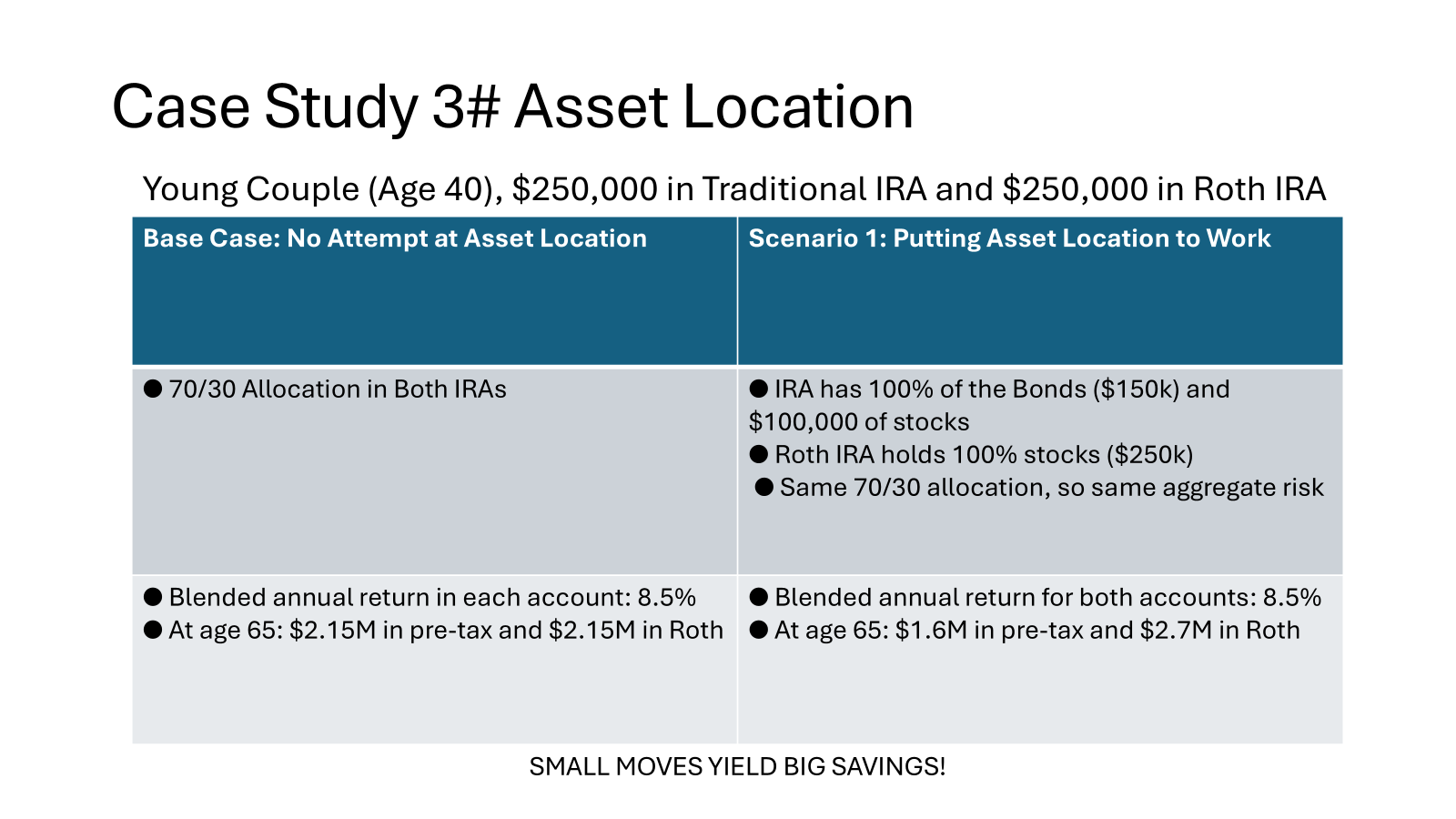
A young couple, age 40, had $250,000 in a Traditional IRA and $250,000 in a Roth IRA. Both accounts were invested identically: 70% stocks and 30% bonds.

We restructured the portfolio so the Traditional IRA held the bonds and the Roth IRA held all the stocks — same overall 70/30 allocation, but placed more tax-efficiently.

  • Result: Over $600,000 more in tax-free Roth assets at age 90
  • Estimated tax savings: $300,000+
  • Risk: Stayed the same — only the location changed
Same mix. Better location. Dramatically different outcome.
↓ See the impact in the chart below ↓

Case Study #3B – Roth vs Pre-Tax 401(k) Contributions

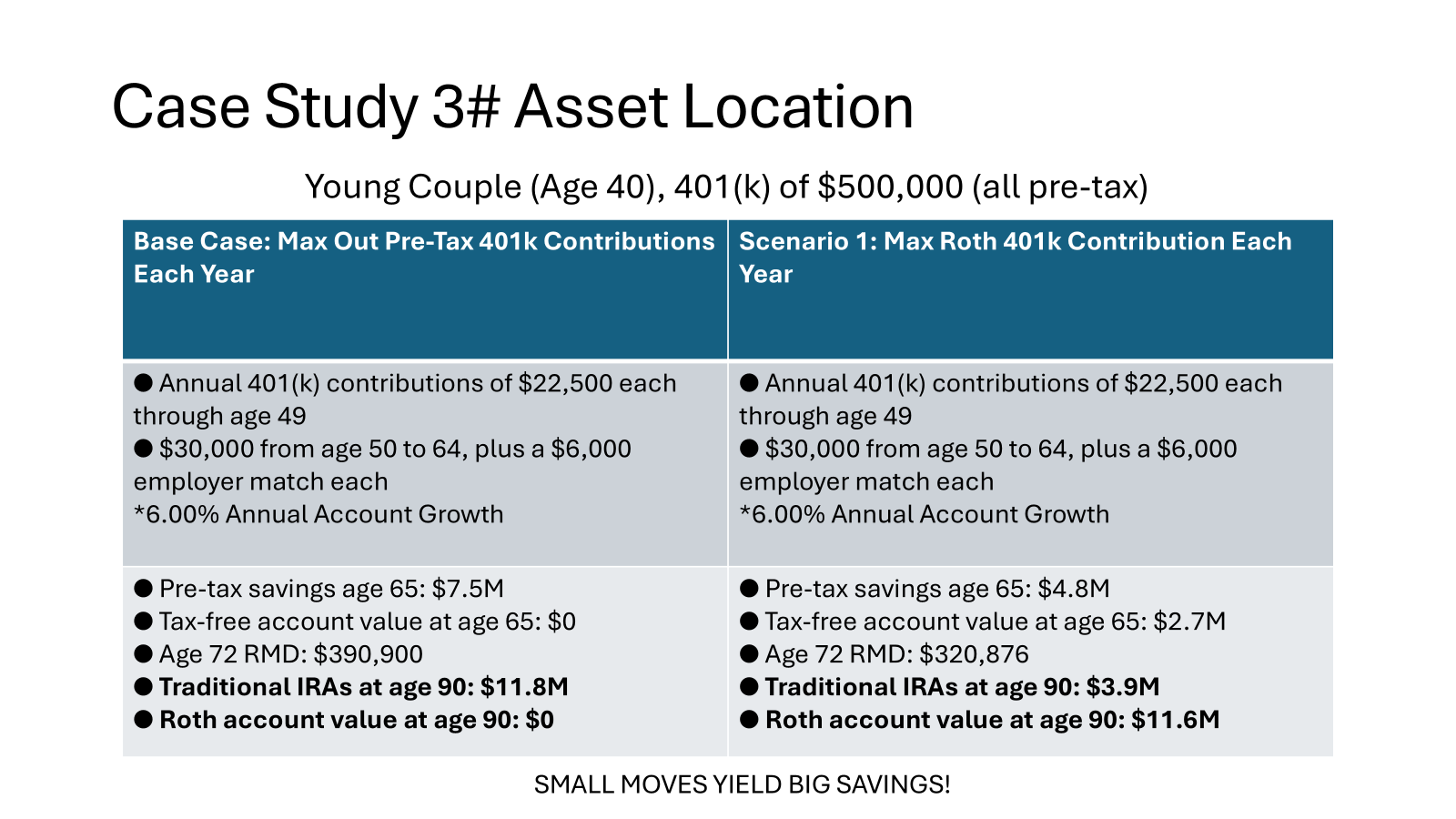
The same couple also asked about which type of 401(k) to fund — traditional pre-tax or Roth. Both had $500,000 in combined retirement savings and were consistently contributing the maximum allowed by law.

We compared the outcome of maxing out pre-tax contributions vs Roth 401(k) contributions over 25 years.

  • Pre-Tax Route: $7.5M at age 65, but high RMDs and $11.8M all taxed at age 90
  • Roth Route: $4.8M pre-tax + $2.7M Roth at age 65, and $11.6M tax-free at age 90
  • Lower RMDs and better long-term tax control
Roth growth + reduced required distributions = more freedom and less tax drag.
↓ Visual comparison of the two strategies below ↓

Speak to Our Professional Team

Let’s talk through your numbers and timeline — before the window closes.

Schedule Your Strategy Session